
WASHINGTON — Christian, Muslim and traditional leaders in Nigeria are banding together as part of a new interfaith effort to find solutions and demand protection from their government, as thousands of civilians are killed each year by communal clashes, banditry and terrorism that have displaced millions over the last decade-plus.
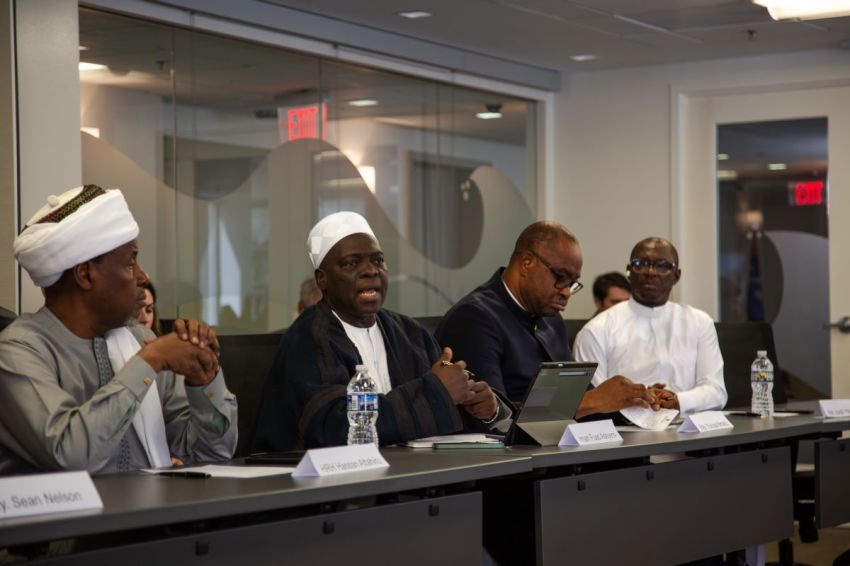
After signing an unprecedented interfaith accord on Dec. 9 in Abuja, a handful of senior Nigerian faith leaders gathered earlier this month for an invite-only discussion, convened by Pepperdine University, the Global Peace Foundation and the Religious Freedom Institute, to offer informed dialogue on the evolving security and humanitarian crisis in Nigeria.
The meeting comes as tens of thousands of people have been killed since the emergence of the Islamic extremist group Boko Haram in northeast Nigeria in 2009. On top of the extremism by terror groups, the lack of security in other regions of Nigeria has enabled gangs to take control of entire villages and carry out mass kidnappings and killings.
The Feb. 4 meeting, which occurred as religious freedom advocates from across the globe gathered in the nation's capital for the sixth-annual International Religious Freedom Summit, included three commissioners from the U.S. Commission on International Religious Freedom who listened intently to what the Nigerian leaders had to say.
While six Nigerian leaders traveled to Washington to attend the meeting in person, several others who signed the recent accord joined virtually. Leaders discussed current conditions, and agreed on priorities and pathways forward.
With U.S. President Donald Trump ramping up his rhetoric against the violence in Nigeria and the recent deployment of 200 U.S. troops to Nigeria, USCIRF commissioners told the Nigerians that there is no better time than now to push their government to protect its citizens and hold bad actors accountable, given the unprecedented attention the issue is now receiving in the U.S.
Speaking with ‘one voice’
The leaders appeared baffled as to why the Nigerian government has done so little to protect its people, thwart attacks or hold terrorists accountable for attacking civilians, which they contend are basic functions for any respectable government. They called on the government to protect vulnerable communities, improve intelligence and rapid response, ensure justice and support victims.
“On Dec. 9, 2025, religious leaders made up of Christians, Muslims, Hindus and traditional leaders from across Nigeria convened for a high-level faith dialogue to discuss the crisis of killings, kidnappings and violence impacting communities nationwide,” Pastor Joseph Hayab, the chairman of the Christian Association of Nigeria, said.
“Guided by the sanctity of life and God’s given dignity of every Nigerian, leaders renewed their commitment to moral leadership, national unity and collective action. … They emphasize that attacks against Muslims or Christians or any community are reprehensible and do not reflect any faith. … The religious leaders agreed to speak with one voice to denounce violence, promote peace and uphold the dignity and rights of all Nigerians, regardless of religion or ethnicity.”
The accord urged Nigerians to “take responsibility to solve our problems,” with Hayab saying, “No one from outside can genuinely solve it.”
One of the steps the leaders agreed on at the Dec. 9 gathering was to create a joint interfaith advocacy committee to coordinate information sharing and unified action. They also agreed to strengthen community early warning systems, an effort that includes the use of “informal peace firefighters.” They also seek to “reactivate traditional conflict resolution mechanism.”
“We agreed to launch nationwide interfaith peace messaging, including sermons, media engagement and youth and women-led initiatives promoting unity and dignity,” Hayab said.
The discussion was moderated by the Rev. Fr. Canice Chinyeaka Enyiaka, who said that Nigerians are “deeply religious” and that any peace process must engage “the role of faith leaders.”
“The meeting was solution-oriented,” he said. “The faith leaders did not engage in name-calling. They were looking for a way forward.”
‘Compass in their pocket’
John Cardinal Onaiyekan, the 82-year-old Roman Catholic Archbishop Emeritus of Abuja, didn’t mince words during the meeting. He said that when Nigeria was under British rule before it gained independence in 1960, many Nigerians dreamed of the day when Nigeria would become a powerful nation like the U.S., the United Kingdom, France or Germany.
“The older generation is aware of what a good country should be,” Onaiyekan said. “My fear is that the younger generation no longer even knows what it means to have a good country.”
“We believe that the religious leaders should do more to be able to help those who rule our nation to be consistent with the faith, which we say is given the good guidance someone mentioned about moral compass,” he continued. “And my feeling is that, even though the moral compass is there, many of our leaders have decided to put the compass in their pocket and are not really too interested in being guided.”
With millions displaced across Nigeria, USCIRF commissioners asked about the state of internally displaced people, many of whom have lived in degrading conditions at IDP camps for years with no hope of returning home to their towns overrun by terrorists.
For people who have stayed in their towns after being overrun, leaders said they are subject to the conditions set by the extremists who have been allowed to establish de facto governance in those areas.
‘Should not be happening in the year 2026’
“Things are happening that should not be happening in the year 2026,” the cardinal stated. “That should not be possible for terrorists to occupy and govern spaces freely. The [government leaders] will not come to campaign, but they will get votes … deceiving us.”
Speakers lamented that when military, police or other security forces are sent to respond to attacks on villages, they often “come in unprepared, without any strategy.”
Hassan Attahiru, the emir of Bungudu in Zamfara State, a Muslim traditional ruler who was kidnapped by bandits in 2021 and held captive for over a month, said the IDP issue is often related to the lack of protection for the “ungoverned spaces where they left.”
“We still have not focused on trying to reclaim those territories,” Attahiru said of the government’s response. “To me, that's where we should have passed that stage by now, at least in some stages. … The way things are now, if we are able to reclaim a territory and then encourage those people to come back to their houses, their homes are still there. And so, whatever you are thinking of getting [IDPs] support or getting them supplies, it's not going to work if we don't reclaim those territories and then they go back to their place.”
Despite government inaction, the traditional ruler said a lot of the problems facing Nigeria are “self-created.”
“All of us are responsible,” he said. “Just not sit down and then suddenly blame it on the government or politicians. It's all part of us. It will be our ability to really work together and solve this problem.”
“[The problems] did not start under the Tinubu administration, but then leaders are always measured by how much they have worked towards solving inherited problems,” Attahiru added. “[T]hat's what makes the difference between a good leader, or even an ordinary leader, a great leader. So it's the responsibility of the president and other organs of government to ensure that they show transparency in the actions they show.”
With an office in Washington, the California-based Pepperdine University has formed relationships in 20 African countries seeking to promote justice reform. Daniel J. DeWalt, senior vice president for Global Impact and chief of staff at Pepperdine University, said the university wants to invite the Christian and Muslim leaders to meet with the Nigerian chief justice to “work toward an agreement that all could sign to speak with one voice to create a peace agreement that could be built upon.”