
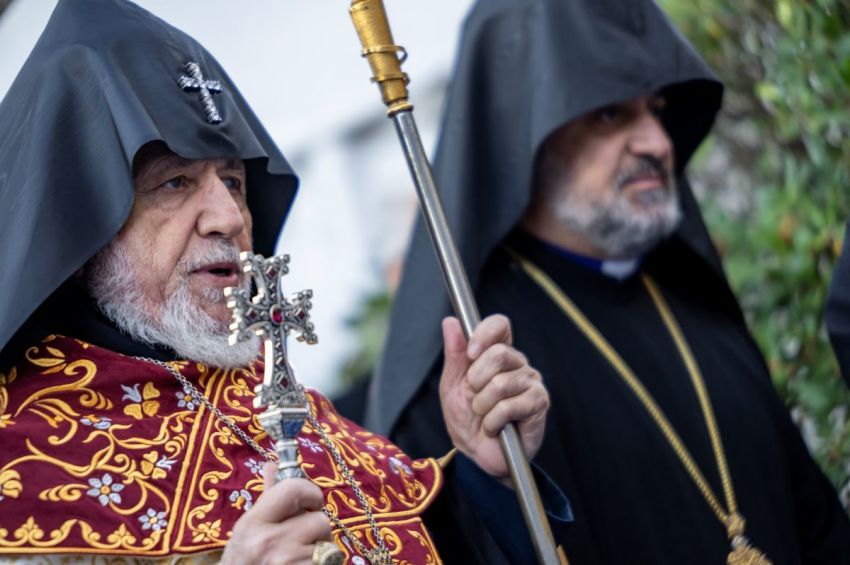
Prosecutors in the world’s first Christian nation have brought criminal charges against the head of one of the world’s oldest Christian bodies, drawing concern from rights groups amid worsening tensions between Prime Minister Nikol Pashinyan and Armenian Apostolic Church leaders.
Armenia’s Prosecutor's Office has opened criminal proceedings against Catholicos of All Armenians Karekin II and banned him from leaving the country, effectively preventing him from attending the planned Armenian church assembly in Austria this week.
In a report reviewed by The Christian Post, the Armenian Center for Political Rights, a watchdog that has been critical of the government's arrest of church leaders in recent months, tied the catholicos' prosecution to the defrocking of Bishop Gevorg Saroyan, a Pashinyan-aligned cleric who previously served as primate of the Masyatsotn Diocese and is among those calling for the catholicos’ resignation.
After removing Saroyan from office in January, a court of General Jurisdiction of Armavir Marz ordered the Apostolic Church “to ensure Gevorg Saroyan’s continued exercise of the office of Diocesan Primate and to refrain from obstructing it pending final adjudication of the case,” the Armenian Center for Political Rights notes.
Two days after Saroyan was defrocked on Jan. 27, the Investigative Committee of Armenia brought charges against six bishops for defying a judicial act and prevented them from leaving the country.
The Feb. 14 charge against the catholicos is based on the same grounds as those brought against the six bishops in late January, the Armenian Center for Political Rights stressed, calling the prosecutions an “undisguised attempt to prevent their participation in the Episcopal Assembly” in Austria.
“This prohibition results from a grave violation of the Constitution and of the ECHR, in particular the State’s obligation not to interfere with the autonomy of religious organizations,” the center warned. “As a consequence, not only the rights of the AAHC under Article 9 of ECHR, but also the rights to freedom of peaceful assembly and association, are infringed. Within the meaning of the Convention, such actions are directly prohibited by Article 18.”
Religious freedom advocacy groups and persecution watchdogs have spoken out for months against the government’s arrests of several church leaders in the last year, including senior clerics Archbishop Bagrat Galstanyan, Archbishop Mikael Ajapajyan, Archbishop Arshak Khachatryan and Bishop Mkrtich Proshyan.
The Armenian government has filed multiple charges against the archbishops and bishops, including plotting to overthrow the government, coercing citizens to join protests, obstructing judicial acts, and, in one case, involvement in planting drugs during a 2018 demonstration. Authorities claim these actions amount to attempts to destabilize the state.
With 2026 being an election year in Armenia, Galstanyan is a vocal critic of Pashinyan and is the leader of the Sacred Struggle opposition movement. In a recent letter sent to leaders of the International Religious Freedom Summit in Washington this month, Galstanyan said his only offense was speaking “an unwelcome truth” and claimed that Armenia is being turned into a “vassal state.”
Pashinyan rose to power in 2018 on the back of a pro-democracy movement, but critics say that his government’s actions have echoed “Soviet-era tactics.”
In a statement last month, the Vienna-based Forum for Religious Freedom Europe said the government’s prosecutions raise “serious alarms about violations of freedom of religion or belief (FoRB) in a country that proudly claims to be the first nation to adopt Christianity as its state religion in 301 AD.”
The forum contends that the recent actions “build on a broader pattern of persecution since mid-2025,” adding that four bishops remain in pretrial detention or “imprisoned on charges critics call fabricated.”
“The government has publicly demanded the removal of Catholicos Karekin II, accusing him of illegitimacy and pushing for state-influenced ‘reforms,’” the Forum for Religious Freedom Europe statement reads. “Advocates warn that these measures represent unprecedented state interference in the church’s autonomy, echoing Soviet-era tactics to subordinate religious institutions.”