
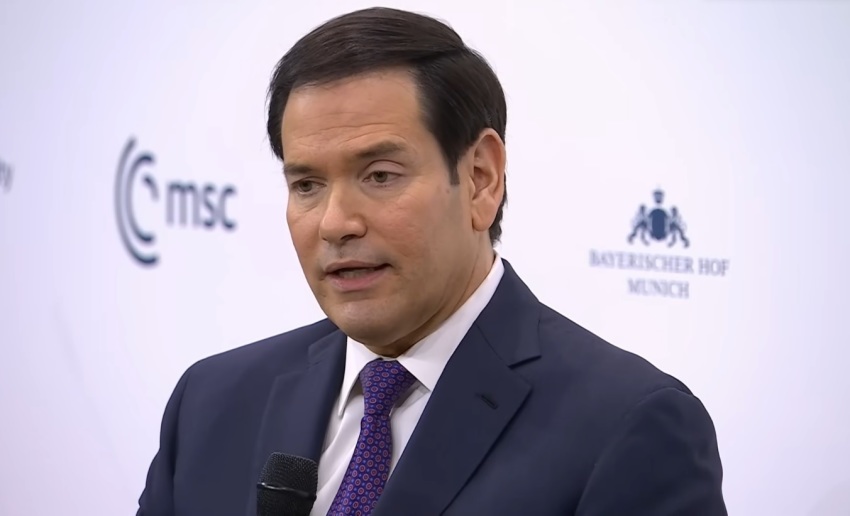
U.S. Secretary of State Marco Rubio received sustained applause Saturday after his speech at a major European security conference in which he praised Christianity as a central part of Western identity and urged tighter border controls.
The Cuban American former U.S. senator also argued for tougher sovereignty, industrial policy and allied defense planning amid wars affecting Europe and the Middle East.
Rubio told the Munich Security Conference that global institutions deliver weak results on today’s major conflicts and require structural change to regain practical influence. He maintained that the wars in Gaza and Ukraine, Iran’s nuclear challenge and Venezuela are examples where decisive outcomes came from national power rather than multilateral process.
"In a perfect world, all of these problems and more would be solved by diplomats and strongly worded resolutions," Rubio said. "But we do not live in a perfect world, and we cannot continue to allow those who blatantly and openly threaten our citizens and endanger our global stability to shield themselves behind abstractions of international law which they themselves routinely violate."
He tied those arguments to a broader critique of post-Cold War thinking that treated borderless commerce and borderless movement as inevitable. Rubio claimed such a worldview is detached from the record of history and produced strategic and social costs across the West.
Migration took center stage in the speech, with Rubio describing border control as a core duty of state authority and a condition for social stability. He presented the issue as a shared political pressure on the United States and Europe and claimed that large-scale flows threaten cultural continuity and public cohesion.
The United States and Europe, the secretary said, are part of a single civilizational bloc linked by shared history, language and Christian faith.
“For the United States and Europe, we belong together. America was founded 250 years ago, but the roots began here on this continent long before. The men who settled and built the nation of my birth arrived on our shores carrying the memories and the traditions and the Christian faith of their ancestors as a sacred inheritance, an unbreakable link between the old world and the new.
“We are part of one civilization — Western civilization. We are bound to one another by the deepest bonds that nations could share, forged by centuries of shared history, Christian faith, culture, heritage, language, ancestry, and the sacrifices our forefathers made together for the common civilization to which we have fallen heir.”
American policy toward Europe, he said, carries urgency because Washington sees the continent’s fate as tied to its own security and identity.
He also connected sovereignty to economic capacity, arguing that policy choices on trade and industrial strategy contributed to deindustrialization and weakened resilience. Rubio described supply chain dependence as a strategic vulnerability, then urged rebuilding production and protecting critical inputs.
The speech moved from industrial renewal to future technologies, including space, artificial intelligence, automation and flexible manufacturing. Rubio urged Western coordination on critical minerals supply chains and on competition for markets in the Global South.
European leaders at the conference proclaimed that deterrence requires stronger military capability and readiness to use force if necessary, The Telegraph reported.
Britain’s Prime Minister Keir Starmer called for Europe to build hard power, described Russia as the aggressor in Ukraine and said peace requires credible security guarantees.
Ukraine’s President Volodymyr Zelensky said Russian strikes have damaged every power plant in the country and warned that Moscow continues attacking infrastructure to pressure Kyiv during winter. He also called Putin a "slave" of war and urged faster delivery of air defense support.
U.S. President Donald Trump urged Zelensky from Washington to move faster toward ending the war, stressing that a deal is possible and pressing for momentum. The comments added to the diplomatic pressure surrounding the weekend meetings.
During a question-and-answer session, Rubio said uncertainty remains over whether Russia seeks a serious end to the war and said the U.S. will keep testing Moscow’s intentions. He said the hardest issues remain unresolved, even as technical contacts between military officials have begun and more meetings were expected.
Rubio said sanctions on Russian oil remain in place, and talks with India produced a commitment to stop buying any further Russian oil. He also said weapons support linked to the conflict continues through U.S. sales supporting Ukraine’s war effort.
A later question turned to China and a planned Trump-Xi meeting in about two months, with Rubio arguing that major powers have a duty to communicate even amid rivalry. He said U.S. and Chinese interests often diverge and trade decisions between the two economies carry worldwide consequences.